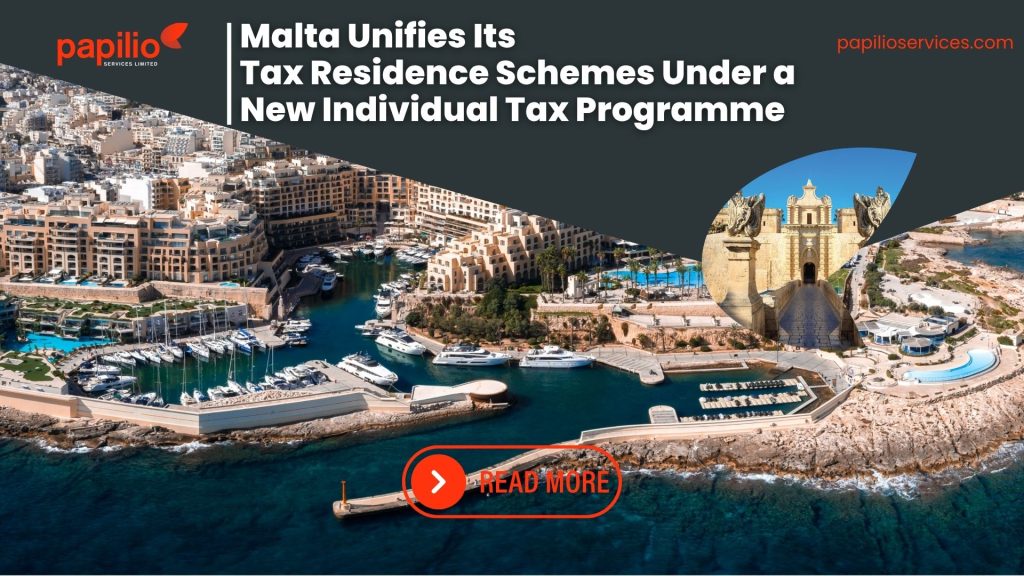
As jurisdictions around the world continue to refine their residency and tax frameworks, Malta has introduced a major overhaul of its special tax residence regime. Effective from 1 January 2027, the country will replace its existing collection of tax residence and retirement programmes with a single legislative framework known as the Individual Tax Programme Rules, 2026.
The reform represents one of the most significant changes to Malta’s international tax residence offering in recent years. While the country’s hallmark 15% tax rate on qualifying foreign-source income remitted to Malta remains intact, applicants will encounter substantially higher entry thresholds, increased minimum tax obligations, additional compliance requirements, and a new renewable status structure.
A Transition from Multiple Schemes to One Unified Framework
Historically, Malta administered several distinct residence-based tax programmes, each with its own eligibility criteria, property requirements, and minimum tax commitments. Under the new rules, future applicants will apply through a consolidated framework offering four separate categories of special tax status rather than entirely separate programmes.
The four categories are:
• Global Resident Status, aimed at qualifying third-country nationals.
• EU, EEA and Swiss Resident Status, designed for eligible European nationals.
• Retired Pensioner Status, intended for individuals whose pension income represents the majority of their chargeable income.
• United Nations Pensioner Status, for qualifying recipients of United Nations pensions and related survivor benefits.
This streamlining is intended to create greater consistency across Malta’s residence-based tax offering while maintaining different pathways for various applicant profiles.
Key Changes for Future Applicants
Although Malta continues to offer its preferential 15% tax rate on qualifying foreign income received in the country, several financial thresholds will increase significantly from 2027 onwards.
One of the most notable changes concerns property requirements. The minimum qualifying property purchase threshold will increase to €700,000 nationwide, while the minimum annual rental threshold will rise to €14,000.
Minimum annual tax liabilities are also increasing across all categories. Depending on the status sought, applicants may face substantially higher annual tax commitments than those currently required under existing programmes.
In addition, a standard application fee of €8,500 will apply under the new framework.
The 15% Tax Advantage Remains
Despite the reforms, Malta has preserved the features that have traditionally made its tax residence programmes attractive to internationally mobile individuals, retirees, entrepreneurs, and investors.
Eligible beneficiaries will continue to enjoy:
• A 15% tax rate on qualifying foreign-source income remitted to Malta.
• Access to double taxation relief where applicable.
• No Maltese tax on foreign-source income that is not remitted to Malta.
• No Maltese tax on foreign capital gains, even when proceeds are brought into Malta.
These provisions remain central to Malta’s appeal as a residence jurisdiction within the European Union.
Introduction of a Renewable Five-Year Status
A fundamental structural change under the new rules is the move away from an indefinite special tax status model.
From 2027, approvals granted under the Individual Tax Programme Rules will be valid for an initial five-year period. Beneficiaries will then be required to apply for renewals every five years and pay a renewal fee of €2,500. Continued eligibility will depend on ongoing compliance with the programme’s requirements.
This shift reflects a broader international trend towards greater oversight and periodic review of residence-based tax programmes.
Transitional Protection Creates a Limited Planning Window
One of the most important aspects of the reform package is the protection granted to existing beneficiaries and near-term applicants.
Individuals who obtain approval under the current framework before 31 December 2026, as well as those who submit qualifying applications by that date, will continue to benefit from the existing rules until 31 December 2031.
This means they may retain access to current property thresholds, existing minimum tax obligations, present fee structures, and the current programme conditions for an extended transitional period, provided ongoing compliance requirements are met.
Applicants submitting from 1 January 2027 onward will instead be assessed exclusively under the new rules.
What the Reform Means for International Residents
Malta’s latest legislative changes demonstrate a balancing act between preserving competitiveness and strengthening regulatory standards. The government has maintained the headline tax benefits that have historically attracted foreign residents while simultaneously introducing higher economic and compliance expectations.
For prospective residents, retirees, and internationally mobile families, the period before the end of 2026 may present an important opportunity to evaluate available options and determine whether applying under the current regime remains advantageous.
Conclusion
The Individual Tax Programme Rules, 2026 mark a new chapter in Malta’s tax residence landscape. By consolidating multiple programmes into a single framework, Malta is creating a more standardised and structured system while retaining many of the fiscal advantages that continue to attract global investors, pensioners, and expatriates.
As implementation approaches, individuals considering Malta as a residence jurisdiction should carefully assess the implications of both the transitional provisions and the future framework to ensure their plans align with the evolving regulatory environment.
Disclaimer: This article is provided for general information purposes only and does not constitute legal, tax, or financial advice.
Insights › Article
Article
Malta Unifies Its Tax Residence Schemes Under a New Individual Tax Programme